

This is a response to a blog post called "When will White People Stop Making Movies like Avatar?" by Annalee Newitz. The post made me upset when I first read it, but I hadn't seen Avatar yet, and besides, her argument is protected by the good old rhetorical ploy, "If this makes you feel defensive, you must be a racist." Now that I've seen the film, I disagree more strongly on a number of points and would like to share, because I feel that a lot of people have been misled and missed the point of the film. And that's a shame, because this film has given me more hope than anything since Obama's election.
Responding to common criticisms
First, let's take care of the allegation that the film is racist, or even about race. The discrimination I saw in the film is not racially based: the humans don't call the Na'vi "Smurfs" or "blue monkeys" or something (it's the movie reviewers who are doing that), they call them "savages." Meanwhile when the Na'vi initially reject Sully it's not because he's a different color or even from a different planet, it's because his worldview is "insane." In other words, this is a culture clash, not a racial prejudice. Once Sully adopts the Na'vi's way of thinking, they welcome him and (most of) the humans reject him. So race is not the real issue here -- it's a red herring. I don't remember hearing a single racial slur in the whole movie, and I was listening for them. (If I missed one, please comment below.) District 9 is about race. That's a different movie. I could turn Newitz's rhetoric around here and say that if all you can see going on in Avatar is race conflict, maybe you're a racist.
How about the "noble savage" criticism -- is Avatar putting Earth's indigenous peoples on a pedestal? The nobility of the Na'vi does not come from the primitiveness of their technology or their tribal social structure, but from their very conscious, intentional interconnection to the natural world around them, which is anything but savage. Calling the Na'vi noble savages is an excellent example of the pre/trans fallacy: people who have a rational worldview are mistaking a trans-rational worldview for a pre-rational one. Putting a more advanced worldview than our own on a pedestal is appropriate -- it's something we can aspire to.
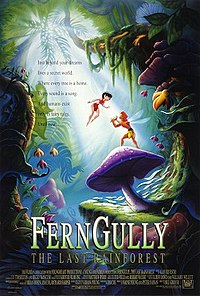 Second, the widespread criticism that the plot is derivative. Everybody and their dog seems to want to compare this plot to other stories, most commonly Dances with Wolves. For my part, it seems clear to me that it's closest to FernGully: The Last Rainforest or Disney's Pocahontas, with perhaps some Princess Mononoke and Final Fantasy: The Spirits Within thrown into the mix. If you're looking at the dynamic between Jake Sully and the Na'vi, A Princess of Mars is a close fit -- Dune is a nice try, and District 9 is just completely off the mark. (Seriously, Ms. Nimitz, how can you compare Sully to the messiannic Muad'Dib and to bumbling antihero Wikus in the same paragraph? They're completely different archetypes.) Regardless, when was the last time you encountered a plot that wasn't derivative of anything? So what? What matters is the story, and in particular the point of the story.
The point of the story
This brings us to the idea that Avatar about past atrocities committed by white people against indigenous peoples, and that its point is to absolve white guilt. Yes, the Na'vi dress and act a lot like some of the many and varied indigenous peoples on Earth. I was particularly struck by their ritual where they sit in a circle chanting and waving in unison, because it looks uncannily like one in the documentary film Baraka. But they are different enough from any specific culture (and our indigenous cultures are different enough from each other) that painting them with the same brush is inappropriate. Besides, in my experience, the percentage of white people who feel guilty about what their/our ancestors did is inconsequentially tiny. Those who feel white guilt may be outspoken, but they are not particularly influential or powerful in society. The white people who are in power do not feel guilty for the sins of their fathers, as a rule; they're too busy committing their own! Why would a writer-director of James Cameron's caliber invest hundreds of millions producing and releasing a film in every country of the world just to soothe the guilt of a tiny, largely powerless minority in the United States? That would be an astoundingly poor marketing plan.
No, it seems clear to me that, as is commonly the case with science fiction, the situation being portrayed through Avatar's metaphors is not in our past or future, but our present. The point of the film is the same one that films like Fern Gully and Princess Mononoke have tried to make, that we are not separate from nature, that on the contrary we are inextricably linked to all of Creation, and it is when we imagine ourselves to be separate that we commit atrocities. This is not just something our ancestors did, we're doing it right now, and we need to stop or we will destroy ourselves. The humans and the Na'vi represent alternative worldviews available to all of us, and the godlike Ey'wa is Pandora's rather more advanced equivalent of our own Gaia.
The illusion of separateness is what the Na'vi identify as "insanity" in the starpeople. It's the same judgment that Derrick Jensen (esp. The Culture of Make Believe) and Daniel Quinn (esp. The Story of B) make in all their books, but it rings much louder in surround sound in theaters everywhere than it does on the printed page. Despite this, Quinn felt compelled to criticize Avatar. The irony of him calling someone else's writing "ham-fisted" and "clichéd," with "two-dimensional characters," is delightful, but alas the fact that so many critics of Avatar have failed to grasp what it's about means that future films will need to be even less subtle in order to reach them.
What is the real avatar?
 So why is Sully a white guy? Why does it take a white guy to lead the Na'vi? Is Cameron trying to say that indigenous peoples can't lead a revolution on their own? If that were his message, the true story of Lawrence of Arabia should be enough evidence that it's not just a white-boy fantasy; there have been times in history when an outsider's perspective and knowledge were instrumental in uniting another people. And if we were critiquing A Princess of Mars, we could legitimately call the storyline condescending to indigenous peoples. But by the time Sully becomes a leader, he is Na'vi for all intents and purposes; he is no John Carter of Mars (right).
I don't think the movie is really about Sully. I don't think the title even refers to Sully's avatar. I think the film itself is the avatar, meticulously designed to allow the people most responsible for destroying our world (our culture, and specifically aggressive white males) to personally experience an alternative worldview.
In the film, it's explained that an avatar has to be tailored specifically to its "driver," and the driver has to be put into a dreamlike state in sensory deprivation. So if the film itself is to be an avatar for the audience, then it must be tailored for us, and we must be drawn completely into its reality and walked through the transition from our own worldview to the Na'vi's. And that is in fact what I saw. Consider:
- Sully is a member not only of the oppressing species, but also a white man and a Marine. So the aggressive white male population, infamous for our inability to empathize with people who look different from ourselves, have someone to identify with. The rest of the audience is accustomed to white male protagonists, so they can cope!
- Sully has at least three distinct motives for entering the avatar program: scientific, military, and personal. So if you find any of those motives objectionable, he's still got two more chances to earn your sympathies.
- Sully's character develops over the course of the film, allowing us to make the transition to a Na'vi worldview along with him. If the other characters are two-dimensional, that just casts him (and by extension, us) into stronger relief. That's nothing new in fiction, and I think it was well done here.
- The much ballyhooed animation and 3D presentation are exquisitely convincing, or at least I found them so. I hear that's less the case in IMAX, so see it in RealD if you can. The only way the movie could have been more fully immersive for me is if I'd had a catheter. What ever happened to intermissions?
- The science is plausible, so even hardcore skeptics can suspend their disbelief. Here are just a few of the articles in which scientists applaud the film's accuracy: Popular Mechanics, MSNBC, Ain't It Cool News. Also, the Na'vi language was created for the purposes of writing the dialogue, so they're not just speaking an obscure human language or babbling like Ewoks -- that's a plus.
- What holes there are in Avatar's science can be explained as concessions to the rest of the audience or to the telling of the story: if the Na'vi had two sets of arms like all the other Pandoran creatures, for example, or if Pandora's low gravity were shown on screen instead of just mentioned, the less geeky types in the audience might have lost their suspension of disbelief. If the humans had wanted to mine unobtanium from the floating mountains (where any moron can tell it is plentiful, due to their floating and all) rather than from under the Home Tree (where its presence can only be detected with instruments), the plot would have had to be restructured. And if Neytiri and Sully had joined their minds during their sex scene, she would have known the humans' plan too early in the plot. And if the corporation had invested its time and money into synthesizing unobtanium on Earth instead of mining it, there wouldn't be a plot at all.
- Although the cast could have featured more female characters, all four of them were sympathetic, strong, admirable people. And there wasn't a single instance of relying on a man to save them; in fact Neytiri and Trudy both save Sully's life repeatedly. So there's no call for a feminist critique.
- There's a romantic storyline, more or less, and enough action scenes (and svelte, scantily-clad bodies) to appeal to the chick-flick and dick-flick fans and ensure that if they don't get the point the first time through, they may get it the second or tenth time.
In summary, I think Cameron did an excellent job of crafting his film to be an avatar for the audience, and particularly for the subset of the audience who most needs to hear its message. The fact that there's another avatar inside the avatar is just a clever narrative device, like Shakespeare's plays within plays.
So why do [white] people keep making movies like Avatar? Because the audience hasn't got the message yet. This is important stuff. The future of life as we know it depends on it. I think Avatar is the best teaching tool we've seen to date. If you didn't become an environmentalist after seeing other films, maybe you will be after seeing Avatar. If not, I hope you'll find reason to watch it again.
Thanks for reading! Comments welcome!
- Log in to post comments